A brief overview of gathered data
I have personally conducted a photographic survey at various locations, in an attempt to shed more light on the phenomenon of 'Orbs', (also referred to as 'Spheres').
The purpose of this study was to eliminate dust, moisture, man-made 'flash orbs' etc, and expose the possible existence of anything which may be truly unexplainable...
Please read the following:
The results of my testing
proved conclusive... many aerial orbs in photos are bogus, in respect that they are nothing more
than distorted reflections of the internal imaging surface of the lens,
amplified due to the flash striking a speck of dust, or water-born
moisture droplets such as humidity, mist, fog, rain, or snow/other particulates.
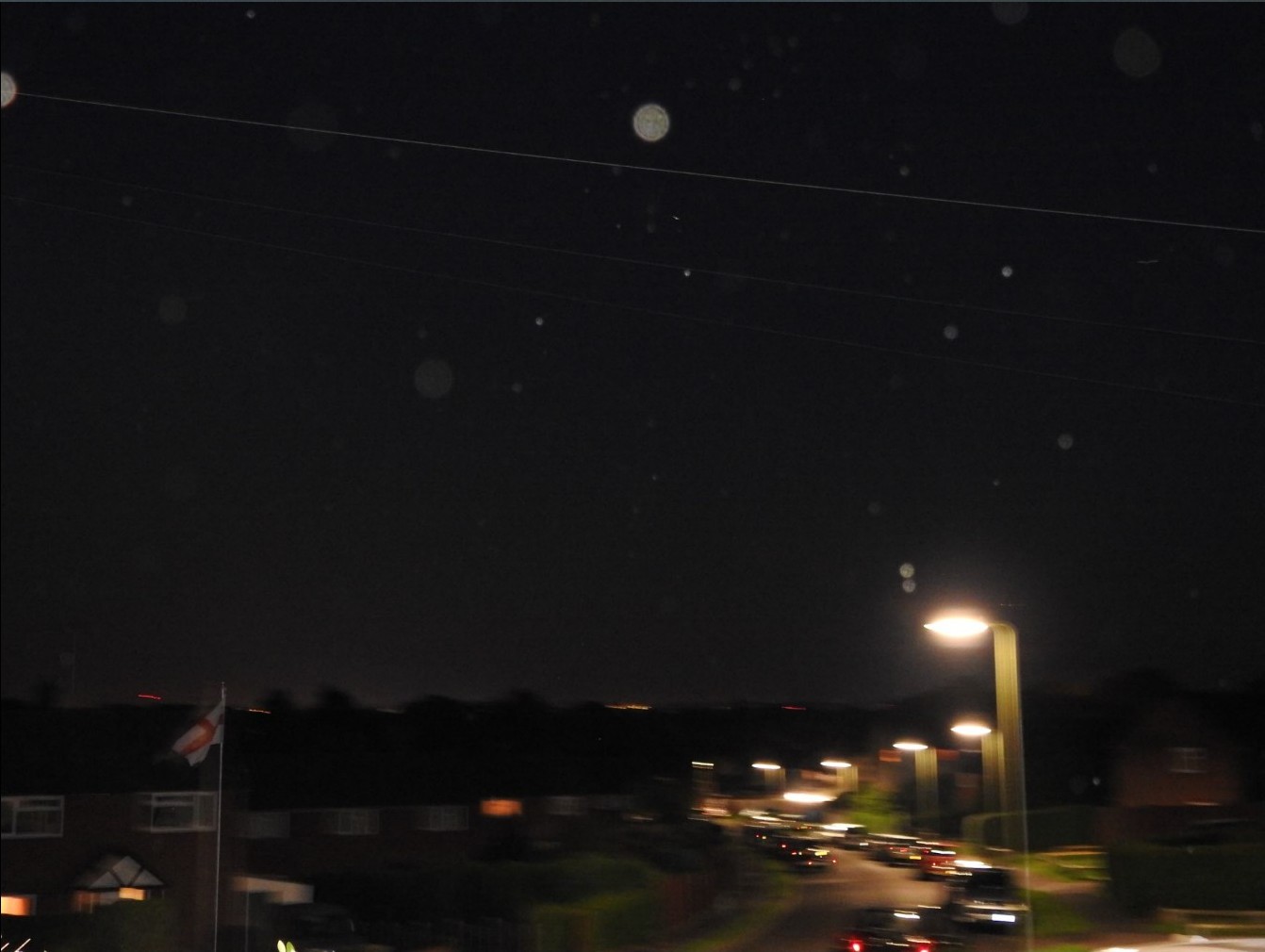
Please click these words to see an example of some moisture orbs that I captured (flash used).
However, I am aware that there is a much rarer type of orb, (which as
yet, I have been unable to capture on camera myself),
that is perplexing some scientists; these objects can move
very fast, up to 500mph or more, and sometimes even appear on
request: Their motions suggest intelligence and intention;
for instance, in dual camera experiments some orbs literally
chose which camera to appear on, or whether to appear at
all.
Here at BEAMS, we have quite a few recorded examples of various
different types of orb phenomena; such as energy vortexes, (vortices),
as some call them: Then there are Glowing Orbs (movie of) and photos of what are known as Supercharged Orbs.
...and, for those who are continuing to believe the nonsense that ALL orbs are simply dust or water spots, let's use a little common sense here:
Dust does not:
- go against the wind
- interact intelligently with people
- move through solid objects
Nor do airborne moisture droplets... and I have seen recorded examples of ALL the aforementioned phenomena.
Yes, you can throw flour and dirt in the air and get orb-type effects, with all the spheres looking the same; yet you don't get multicoloured orbs of various shapes and sizes, some of which when blown up, may have the resemblance of faces and sometimes even what seem to be human figures, inside them!
You can computer generate a bird, but does this make all birds fake? I think not...
Unnatural orbs are:
- Orbs that leave a trail behind them, which indicates movement
- Orbs that are unnaturally bright
- An asymmetrical orb(s)
- An Orb(s) that looks like mini crop circle in close-up
- Oddly colored orbs like bright red or green
- Orbs that appeared without a light source as they are self-illuminating
- Often appear with a purpose near a particular person or an object especially of metaphysical nature like a healing crystal
- They often look two-dimensional instead of one-dimensional like dust
- Do not hold a distinct shape
- They are more dense than natural “orbs”
- Finally, if you are intuitive, just looking at a real orb in a photo will give you a sign that it is real. It may just look a little off, or if you are like me, you may feel goose bumps looking at it.
Also,
please examine this video capture of 'orbular' phenomena, (which I have
dubbed a 'spirit orb') that was seen floating in the
corner of someone's bedroom; the sighting lasted only for a few
minutes, but just enough time for the shocked and astounded witness to
grab his video
camera and catch a short piece of footage, before the large, mysterious
sphere
simply vanished... as is so often the case with Unidentified Flying
Object phenomena: This object was videoed using 'Night shot' - an IR or
infrared feature sometimes found on cameras, which enables short range
recordings to be made in low light.
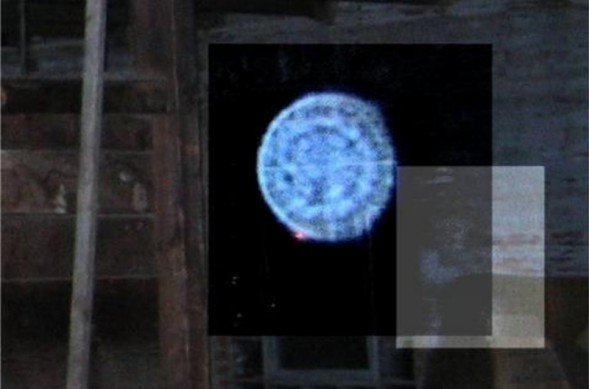
Above: Blue orb and possible ghost image captured in same shot:
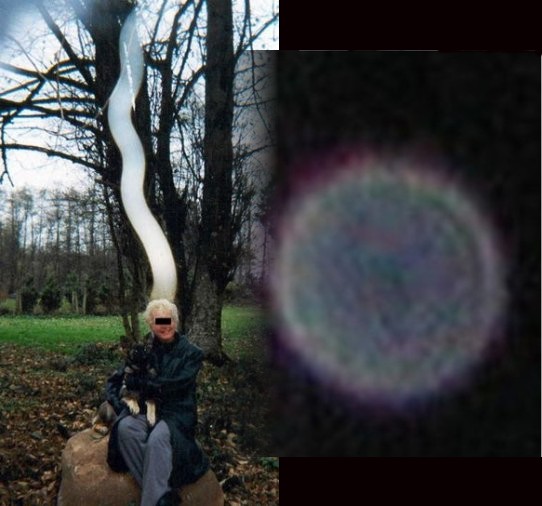
Above:
On the left, a genuine photo of an energy vortex - and for
comparison purposes on the right, is a picture of a humble dust orb:
note the difference of phenomena.
Our conclusions so far:
One good answer as to what these objects actually are, may be to say
that they are some kind of energy plasmas; but to simply give them such
a scientific-sounding label may not be enough, because of their often
and obvious, sentient behaviour.